

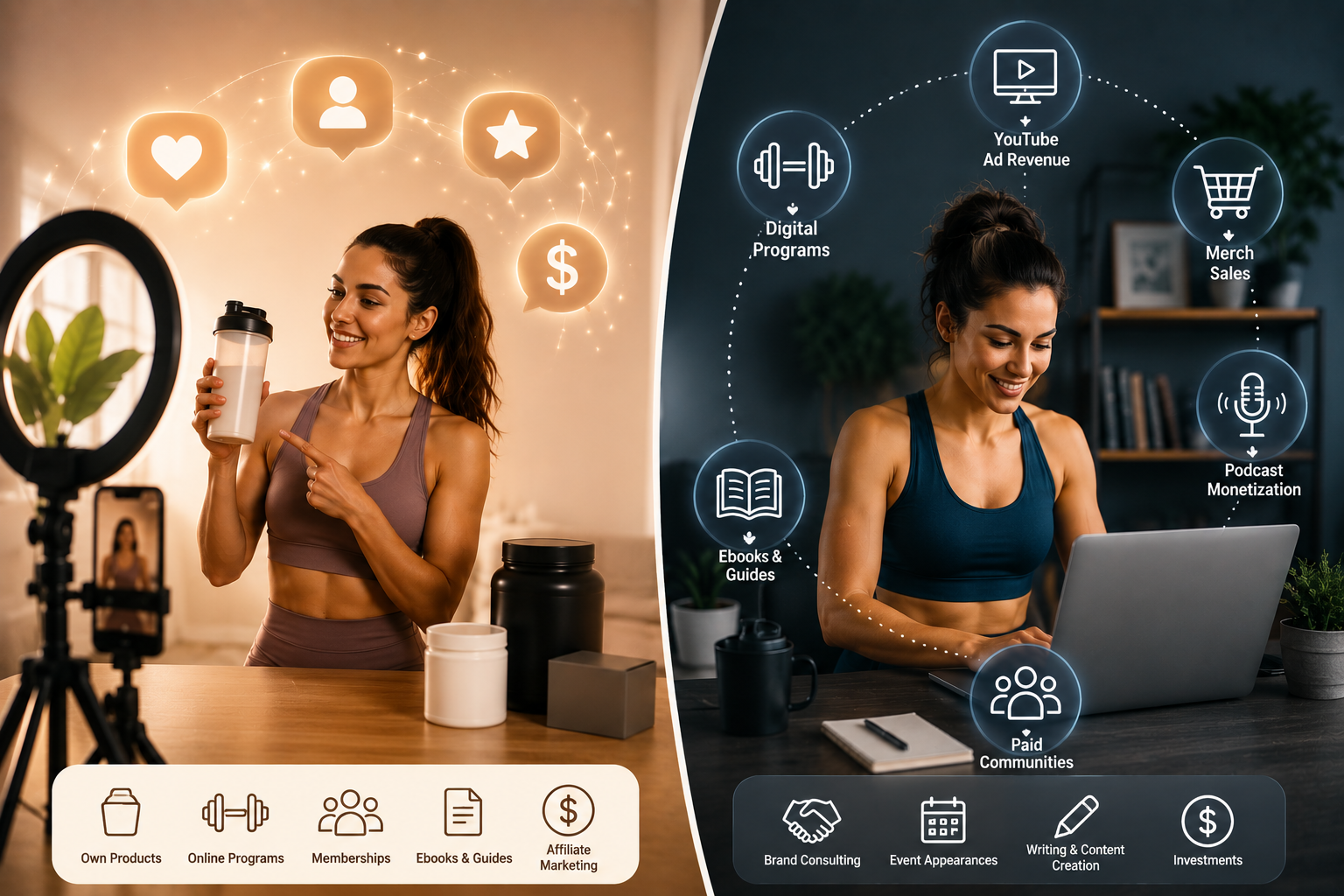
How Fitness Influencers Make Money Beyond Sponsorships In 2026
Most people think fitness influencers make money one way: brand deals. A protein powder here, a gym wear partnership there. And yes, that used to be the main model. But in 2026, the influencers actually building wealth aren't waiting for a brand to call them. They've built their own income and most of it runs without them being online every hour of the day.
This article breaks down exactly how fitness influencers make money today, what's working, what's changing, and what you can start doing if you're a creator looking to build real revenue beyond sponsorships.
Why Sponsorships Alone Are a Fragile Strategy
Let's be direct about something: sponsorships are the most unpredictable income stream a fitness creator can rely on. Brands cut budgets. Campaigns end. Algorithms change and your engagement drops and suddenly the deal you were counting on disappears.
The fitness creators who have been doing this for a few years have learned this the hard way. The ones still standing didn't survive because they had the most followers. They survived because they built multiple fitness influencer income streams that didn't depend on one brand saying yes.
That's the shift. From being paid by brands, to building something brands want to be associated with.
Selling Digital Products: The Biggest Unlock
The single most powerful move a fitness creator can make is turning their knowledge into a product that sells on its own.
Training plans. Nutrition guides. Meal prep templates. Workout programmes designed for specific goals fat loss, muscle building, post-pregnancy recovery, athlete performance. These are things your audience already wants. They're just currently getting a watered-down version of it for free on your feed.
When you package that knowledge properly and sell digital fitness products, something changes. You stop trading time for money. Someone buys your 12-week programme at 2am on a Tuesday. You make money while you sleep. That's not a fantasy that's what platforms built for creators actually make possible.
The question most creators ask is: can a fitness influencer make money selling training plans without a huge following? The answer is yes and consistently. Audience size matters less than audience trust. A creator with 8,000 highly engaged followers who genuinely listens to their advice will outsell a creator with 200,000 passive scrollers every single time.
Before we go further if you haven't read this yet, it's the foundation that makes everything else in this article make sense: Why talking to a real health advisor online beats generic fitness apps. It explains why people are actively seeking expert guidance online right now and that's exactly the demand you're sitting on as a creator.
Paid Chats and One-on-One Access
One of the fastest-growing fitness creator revenue streams in 2026 is charging for direct access. Not group content. Not a course. You, personally, answering someone's question.
This works because people don't just want information they want their specific situation answered. "What should I eat before training?" is a Google search. "What should I eat before training given that I'm 44, have a slow thyroid, and train at 6am before work?" that's a conversation. And conversations have value.
Platforms that support paid per-minute chats or voice calls have made this model highly scalable. You set your rate. You decide your availability. Your most engaged followers pay for time with you, and the experience they get is incomparable to anything they'd find in a generic fitness app.
This is one of the clearest answers to how fitness influencers make money without sponsorships by monetising the relationship they've already built, not chasing external deals.
Subscriptions: Recurring Revenue That Compounds
One-off product sales are great. But subscription income is better because it's predictable.
The smartest fitness creators have built tiered access models. A standard tier might include regular content, weekly check-ins, and a community space. A VIP tier unlocks personalised feedback, exclusive video content, or direct messaging. The audience self-selects based on how much they want to invest in their goals.
This is one of the best ways to monetize fitness content online because the revenue stacks month on month. You're not starting from zero at the beginning of each month hoping a brand deal comes through. You know roughly what's coming in and you build from there.
The Advisor Solution on DoHealthyThings is built specifically for this. It gives creators the tools to set up subscription tiers, manage access, and keep their most loyal followers inside a dedicated space rather than losing them to a social media algorithm.
This connects directly to a bigger concept that more creators are waking up to: What is passive income for health creators and how AI makes it possible. If you want to understand how your content can earn while you're not actively working, that's the read.
PPV Content and Locked Media
Pay-per-view isn't just for live events. For fitness creators, it's one of the smartest ways to monetise high-value content without giving it away for free.
Your best workout breakdown. Your most detailed nutrition protocol. A behind-the-scenes look at how you actually train. These aren't things you post publicly they're things you lock, price appropriately, and let your audience decide if they want in.
The psychology here matters. When something is free, people assume it's worth what they paid for it. When something costs money, they engage with it differently. They follow through. They get results. And then they buy the next thing you release.
This is a significant part of how fitness creators build revenue without brand deals by treating their best content as a product, not a marketing tool.
How Much Can a Fitness Influencer Earn From Digital Products?
This is the question everyone wants a real answer to, so here it is without the fluff.
A creator with a small but engaged audience of around 5,000 to 10,000 followers, selling a training plan priced between $30 and $80, converting even 2% of their audience per month, is looking at $3,000 to $16,000 per month from that single product alone. Add a subscription model, paid chats, and locked content and you start to see how creators who don't have millions of followers are quietly building six-figure businesses.
The ceiling is determined by trust, not follower count. The floor is determined by whether you've built a product worth buying.
If you're wondering how the infrastructure side of this works who manages the tools, the pricing, the strategy behind a creator's business this is a good place to start: What does a fitness influencer management agency actually do? It's a side of the creator economy most people never think about.
Using AI to Scale Without Burning Out
The question of how to make money as a health content creator used to have one answer: work more. Post more. Go live more. Be available more.
That's no longer the only path.
In 2026, the best fitness creators are using AI tools to handle parts of their business that used to eat their time automated responses to common questions, selling products 24/7 without manual effort, personalising the fan experience at scale. This isn't about replacing the human connection. It's about protecting it. When AI handles the routine, you can focus on the creative work that actually builds your brand.
Platforms like DoHealthyThings have this built in. The creator shows up as themselves. The system handles the rest.
The Alternatives to Brand Sponsorships That Actually Work
To make this concrete, here's a direct list of alternatives to brand sponsorships for fitness creators that are generating real income right now:
Selling training plans and nutrition guides one-off digital products, no ongoing effort once created
Subscription tiers regular and VIP levels with different access and pricing
Paid chats and audio calls charging per minute for direct access
PPV locked content premium videos, detailed protocols, exclusive breakdowns
Tip pages a simple, frictionless way for your community to support you directly
Promo codes and flash sales driving urgency and rewarding loyal followers
None of these require a brand deal. All of them require a creator who has built genuine trust with their audience.
Where to Build This
The Knowledges section on DoHealthyThings has step-by-step guides on exactly how to set up each of these income streams from building your first product to growing your audience and turning your content into consistent revenue. It's built for creators who are serious about treating this like a business.
If you're still figuring out where to start, the answer is simpler than it looks. Pick one income stream. Build it properly. Launch it to your audience. Then layer the next one on top.
The fitness influencer income streams that compound over time are the ones that were built intentionally, not thrown together between brand deals.
The Bottom Line
Sponsorships are not a business model. They're a bonus on top of one.
The fitness creators who are genuinely building wealth in 2026 are the ones who stopped waiting to be chosen by a brand and started building something of their own. Digital products. Subscriptions. Paid access. Locked content. Automated income that works while they train, sleep, and live their lives.
The tools exist. The audience is already looking for what you know. The only question is whether you're going to keep giving it away for free.
Start building your income on DoHealthyThings →
FAQs
Q1. How Do Fitness Influencers Make Money Without Sponsorships? By building income streams they fully own. On our platform, fitness creators monetize fitness content online through training plan sales, subscription tiers, paid chats, locked PPV content, and tip pages none of which require a brand deal. The creators doing this well are generating consistent monthly income that does not disappear when a campaign ends.
Q2. What Are the Best Ways for a Fitness Creator to Earn Online in 2026? The strongest fitness influencer income streams right now are digital product sales, recurring subscriptions, and paid direct access. On DoHealthyThings, we give creators the tools to run all of these from one platform: their own storefront, their own pricing, their own audience. No middleman. No brand approval needed.
Q3. Can a Fitness Influencer Make Money Selling Training Plans? Yes and it is one of the most scalable things a creator can do. You build the plan once and sell it repeatedly. On our platform, creators sell digital fitness products, training programmes, nutrition guides, meal prep templates and earn from them continuously without any additional effort per sale. A small but engaged audience can generate significant monthly revenue from this alone.
Q4. How Much Can a Fitness Influencer Earn From Digital Products? It depends on audience trust, product quality, and pricing not follower count. A creator with 5,000 to 10,000 engaged followers selling a training plan priced between $30 and $80, converting 2% of their audience monthly, can earn $3,000 to $16,000 per month from that product alone. Add subscriptions and paid chats on top of that, and the number grows considerably.
Q5. What Are the Best Alternatives to Brand Sponsorships for Fitness Creators? The alternatives to brand sponsorships for fitness creators that we see consistently working on our platform are digital product sales, VIP subscription tiers, per-minute paid chats, PPV locked content, tip pages, and promo code campaigns. These are income streams the creator controls entirely: no pitch decks, no brand approval, no risk of a deal falling through.
Q6. How Do I Start Monetizing My Fitness Content Online? Start with one product. Build it properly. Launch it to your existing audience. Then layer the next income stream on top. On DoHealthyThings, we give you the tools to set up your storefront, price your content, and start selling without needing a large team or technical background. Our Knowledges section walks you through each step in detail.
Q7. Is Fitness Creator Revenue Without Brand Deals Actually Sustainable? Not only is it sustainable, it is more stable. Brand deals are project-based and unpredictable. The fitness creator revenue models we support on our platform are recurring and compounding. Subscriptions renew. Digital products keep selling. Paid chats fill up. When these streams are running together, your income does not drop to zero when a campaign ends.
Q8. How to Make Money as a Health Content Creator When You Have a Small Following? Audience size is less important than audience trust. A creator with 5,000 people who genuinely listen to their advice will outsell a creator with 200,000 passive followers every time. On DoHealthyThings, we have seen creators with relatively small but engaged communities build serious monthly income because they built the right products and priced them correctly for people who actually wanted them.
Q9. What Is the Difference Between Selling Digital Fitness Products and Getting a Sponsorship? A sponsorship pays you once for promoting someone else's product. Selling your own digital fitness products pays you repeatedly for something you created. One builds the brand's equity. The other builds yours. On our platform, we focus entirely on helping creators build and sell their own products because that is where the long-term income and the long-term brand value actually live.
Q10. How Does DoHealthyThings Help Fitness Creators Build Income Beyond Sponsorships? We give creators a full revenue infrastructure in one place. Their own profile page. Digital product hosting. Subscription tier management. Paid chat tools. PPV content locking. Promo code creation. Analytics that show what is actually selling. And an AI engine that keeps selling their products even when they are offline. Everything a creator needs to build a real business without waiting for a brand to say yes.