

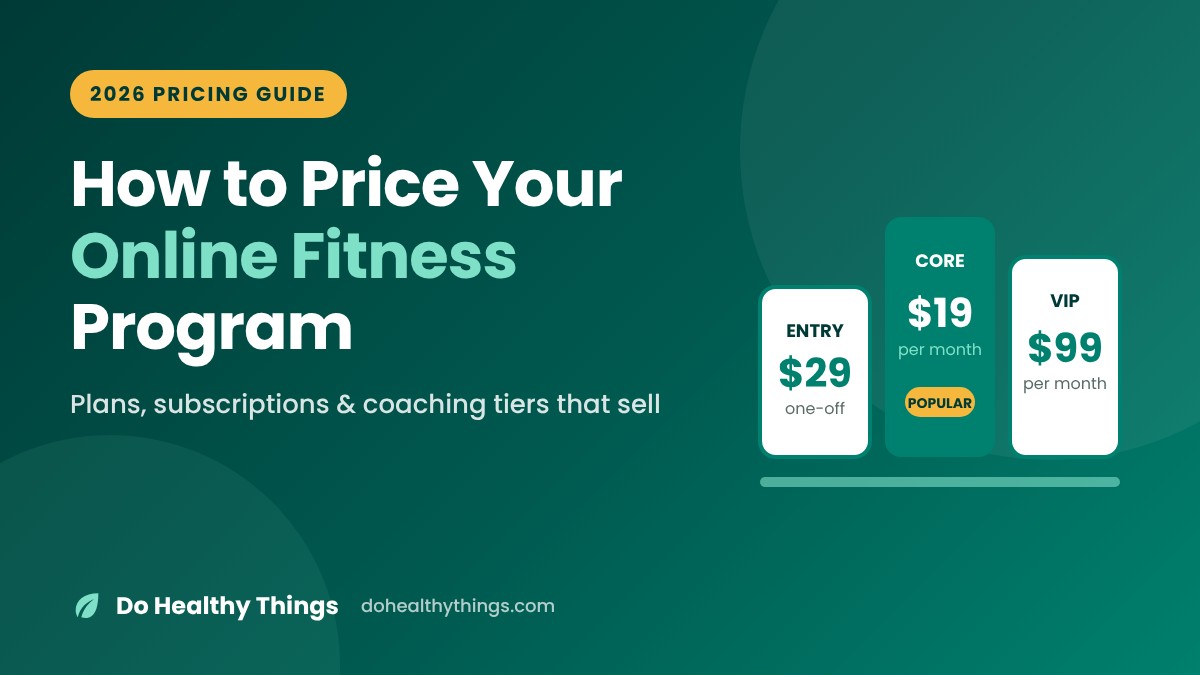
How to Price Your Online Fitness Program in 2026
Most fitness creators don't have a content problem. They have a pricing problem. They charge too little because they're nervous, or too much for a product that hasn't earned it yet, and either way the sales don't come.
In this guide, we'll show you exactly how to price your online fitness program in 2026, from a one-off training plan to a VIP subscription, using the same framework we see working for creators on DoHealthyThings.
Why Pricing Is the Most Overlooked Growth Lever
You can double your income without doubling your audience. Pricing is how.
A creator selling a $19 plan to 100 people earns $1,900. The same creator selling a properly built $49 plan to 70 people earns $3,430. Fewer buyers, more revenue, and usually a more committed client who actually finishes the programme.
Price also signals value. When a plan is priced too low, your audience assumes it's a generic template. When it's priced with confidence, they assume it's built with care.
Step 1: Decide What You're Really Selling
Before you pick a number, be clear about the format. Each one carries a different price expectation.
- Digital training plans and guides: created once, sold repeatedly. Lowest price point, highest volume.
- Subscriptions: ongoing access to your content, updates and community. Recurring monthly revenue.
- Locked PPV content: single premium pieces, such as a full mobility protocol or a competition prep breakdown.
- Paid chat and 1:1 coaching: direct access to you. Your highest price point, limited by your time.
Most successful creators offer at least three of these, so every follower has an entry point that fits their budget.
Step 2: Use the Three-Tier Pricing Model
The simplest structure that consistently converts is a three-tier ladder.
| Tier | What's included | Typical 2026 price range |
|---|---|---|
| Entry | Single training plan or nutrition guide | $19 to $49 one-off |
| Core | Standard subscription: new workouts, monthly updates, community | $9.99 to $29 per month |
| Premium | VIP subscription or coaching: personal check-ins, paid chat, custom plans | $79 to $299 per month |
The entry tier builds trust. The core tier builds recurring income. The premium tier builds your margin. Followers who start at the bottom often move up once they see results.
On DoHealthyThings, you can set up standard and VIP subscription tiers side by side, so this ladder is built into your profile from day one.
Step 3: Price on Outcome, Not on Hours
The biggest mistake personal trainers make when moving online is pricing by the hour. Online clients don't buy your hours. They buy a result.
Ask yourself: what is it worth to someone to lose 8 kg before their wedding, run their first half marathon, or finally do a pull-up? Your price should reflect the value of that outcome, not the time it took you to write the PDF.
A useful test: if your plan delivers what it promises, would the buyer feel they got a bargain? If yes, you're priced correctly or slightly under.
Step 4: Check Your Niche and Audience
Pricing isn't universal. A few factors move your number up or down:
- Specificity: "postpartum strength for new mums" can charge more than "general fitness".
- Credentials and results: qualifications, client transformations and reviews justify premium pricing.
- Audience spending power: a professional audience will pay more than a student audience.
- Support level: anything with personal feedback should cost noticeably more than a self-guided plan.
If you're not sure where you sit, look at your engagement quality rather than follower count. Ten thousand followers who comment and ask questions are worth more than a hundred thousand who scroll past.
Step 5: Launch, Measure and Adjust
Your first price is a starting point, not a commitment. Launch, then watch three numbers for 30 days: conversion rate, refund requests and the questions people ask before buying.
If almost everyone who asks buys, you're probably underpriced. If many people ask and few buy, the issue is often the offer description rather than the price itself. Use promo codes for launches instead of permanently lowering your price, so the full price stays anchored.
Pricing Mistakes to Avoid
- Giving away your best content for free and having nothing better left to sell.
- Offering one product only, with no upgrade path.
- Constant discounting, which trains your audience to wait for a sale.
- Copying another creator's prices without their audience, niche or results.
How DoHealthyThings Makes Pricing Easier
We built our platform so you can test and scale your pricing without juggling tools. Set your plan prices, create standard and VIP subscriptions, lock premium content behind PPV, run promo codes for launches, and let our AI recommend the right tier to each follower based on their goals.
Want to see how pricing fits into your wider income model? Read How Fitness Influencers Make Money Beyond Sponsorships in 2026 and What Is Passive Income for Health Creators, and How AI Makes It Possible.
Set up your pricing tiers on DoHealthyThings →
FAQs
Q1. How much should I charge for an online fitness program?
Most creators in 2026 charge $19 to $49 for a one-off training plan, $9.99 to $29 per month for a standard subscription, and $79 to $299 per month for coaching or VIP access. Adjust based on your niche, results and support level.
Q2. How much do online personal trainers charge per month?
Online personal training with regular check-ins typically ranges from $79 to $299 per month. Highly specialised coaches with strong results can charge more.
Q3. Should I charge a one-off fee or a subscription?
Offer both. One-off plans attract new buyers with low commitment, while subscriptions create predictable recurring income. Together they form a natural upgrade path.
Q4. How do I know if my fitness program is underpriced?
If nearly everyone who enquires buys immediately and nobody questions the price, you're likely underpriced. Test a higher price on your next launch and compare conversions.
Q5. Can I change my prices later?
Yes. Raise prices gradually as you collect reviews and results, and keep existing subscribers on their original rate as a loyalty reward.